
Song while writing: Erna Chimu – Hai Serute
3/10 – Buitepoos border – Gobabis. 113 km, 410m+
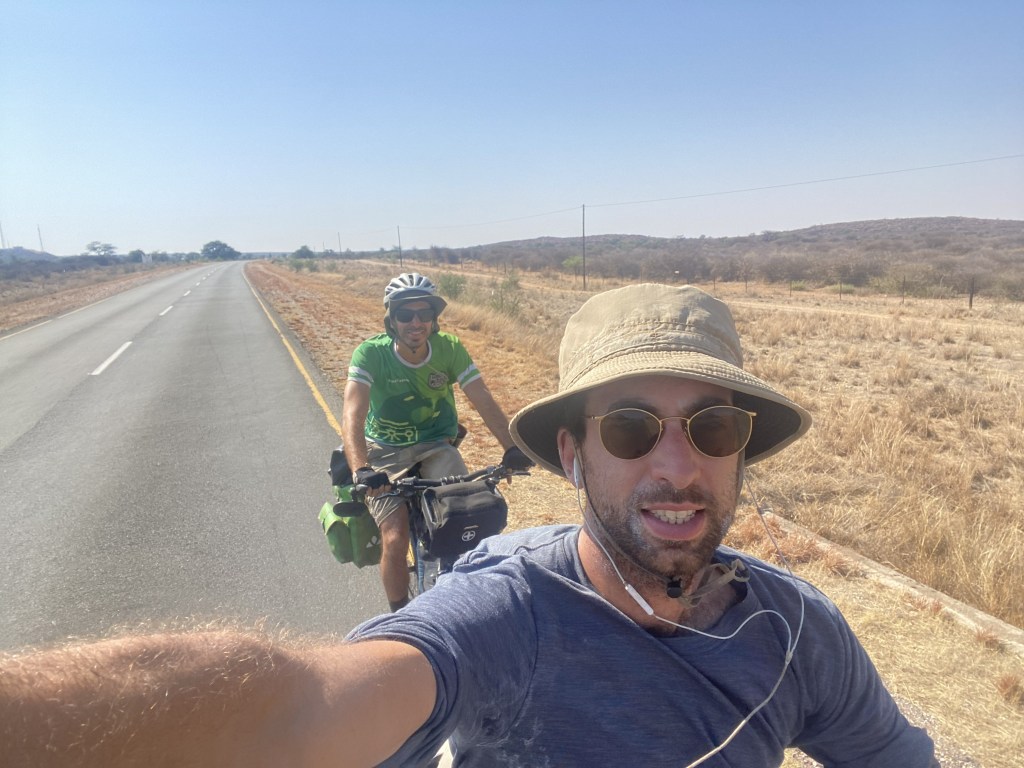
We say bye to the friendly people working at the gas station where we slept in the Botswanan side of the border. It’s 7 AM and they are all working again: the security guy, the restaurant girls… As everywhere so far, they seem to work very long shifts, merging so much their personal and work lives that they sleep at the workplace.
It takes us minutes to arrive to the border, and again just minutes to get the exit stamp from Botswana, and then the Namibian entry one, despite the lady in the Namibian side is far from friendly. She almost kills us for not having a pen to fill in the form, and she even states: “I am not a nice person”. Damn, bad for you!
This is however an exception in Namibia, where the vast majority of the people we have met have been very friendly, despite not being so many them: there are only 2.5 Million Namibians in a country twice the size of Germany. This makes Namibia the 2nd least populated country on earth, only after Mongolia.
Population is very heterogeneous, with lots of tribes, although the main one is the Owambo, with around 50% of population, and very connected to the ruling party: SWAPO. There is a significant minority of Afrikaaners, around 8% of the population, and quite some mixed people with the very unfortunate name of “Basters” (Bastards).
Namibia was a German colony in the early XXth century and there is quite some evidence about it. It was then part of South Africa, having its own type of apartheid and inequality: still after the expropriations of the ruling party (in power since the independence in the 90’s), 4’000 white families control 50% of the fertile land.
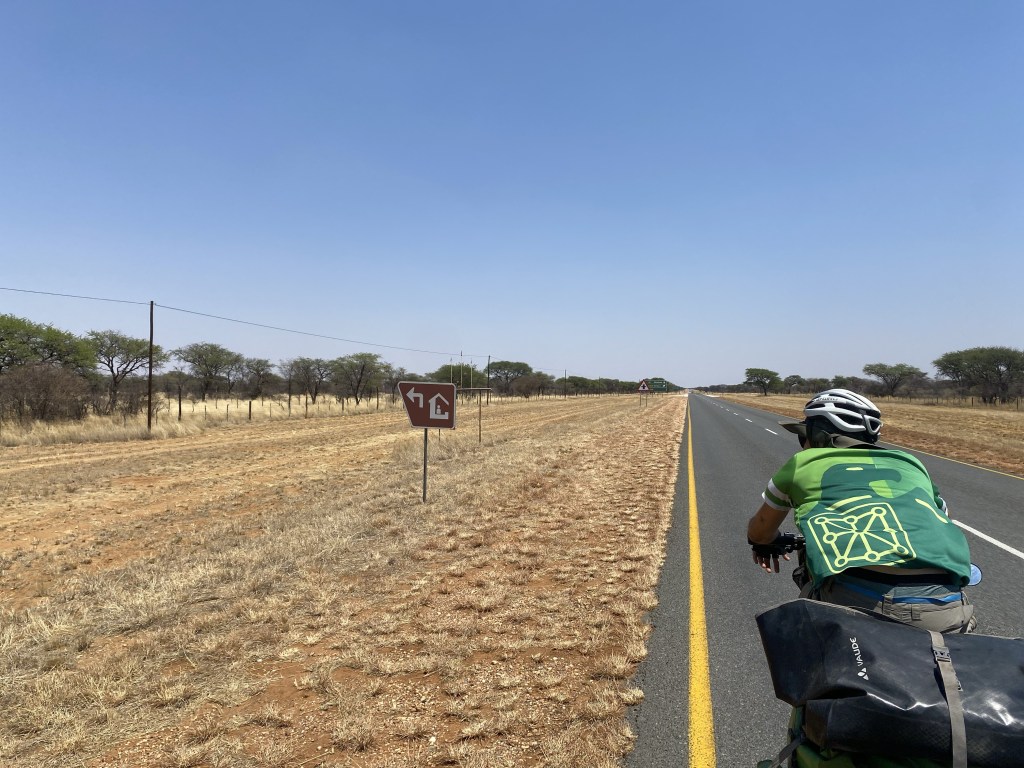
There is no need to believe the theory, we see it with our own eyes. Absolutely every squared meter on the sides of the road until Windhoek is fenced, with imponent entry gates with names in Afrikaans or German. These huge farms are home to a combination of cattle and wildlife, (mostly antelopes and wildebeest) used for hunting safaris or game drives. Somehow, this fact makes the journey less attractive, like if we were fenced too. We are definitely out of danger of an elephant or a lion crossing by.
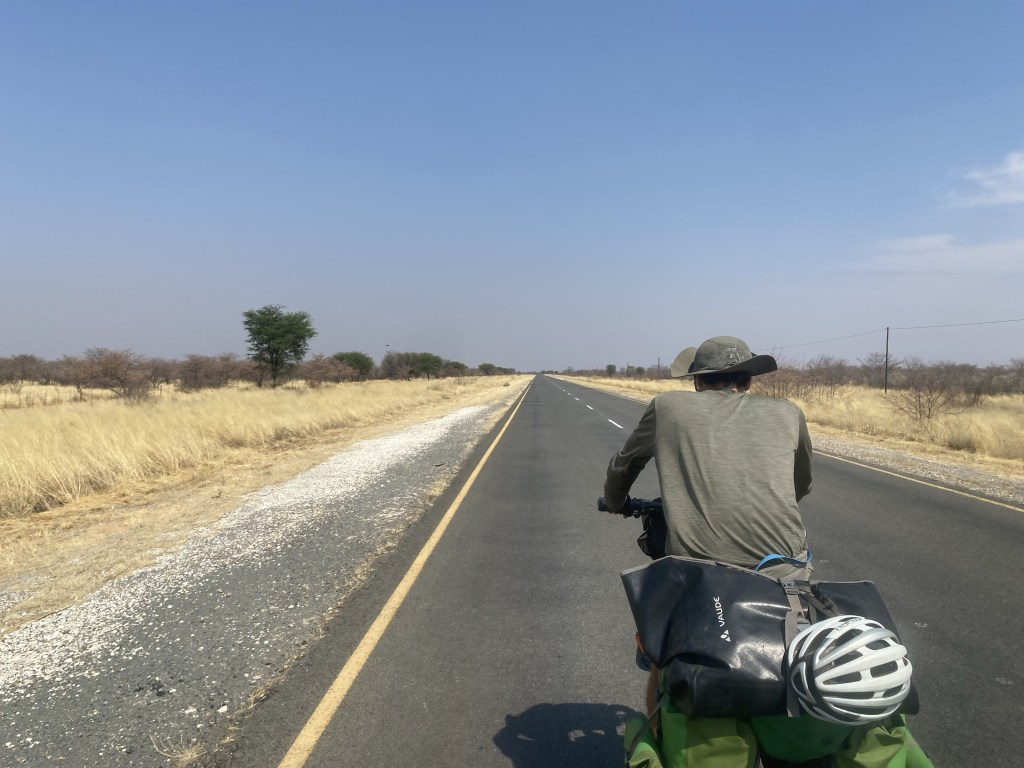
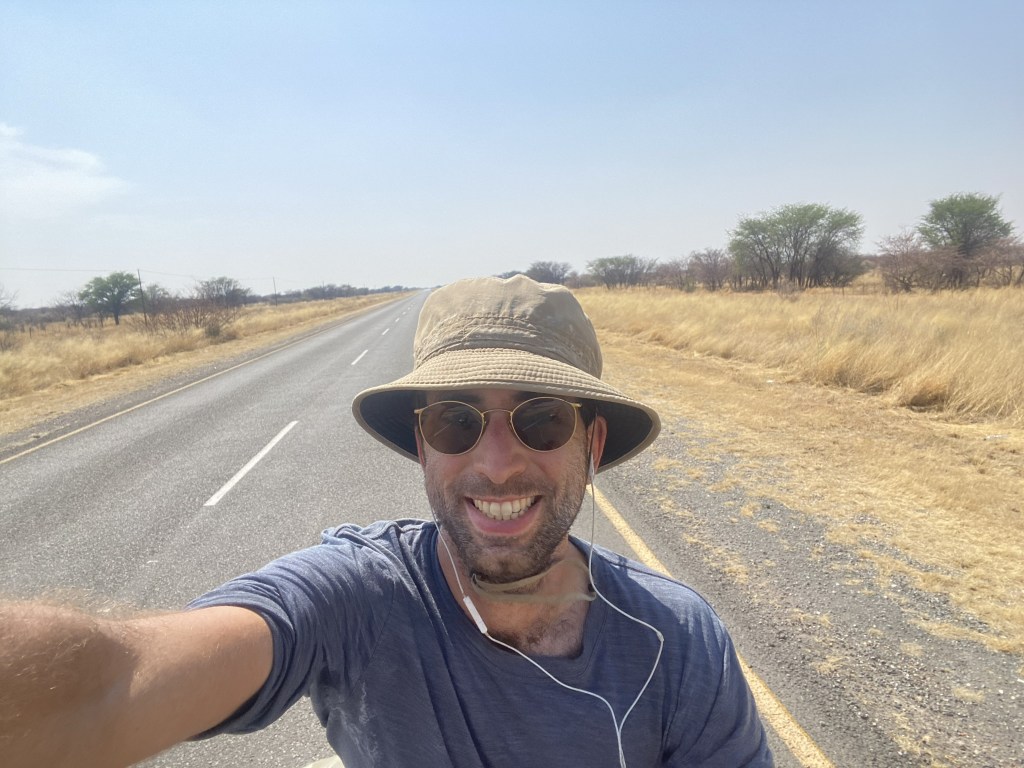
That being said, the road is quite well tarred and seemed to be patched continuously. We notice next to every patch what we can only assume to be the date of the work. Funny way to keep track of things! We quickly notice the missing shoulder which we hope will somehow appear before we reach Windhoek (the capital), as traffic always drastically increases as we get closer to large cities.

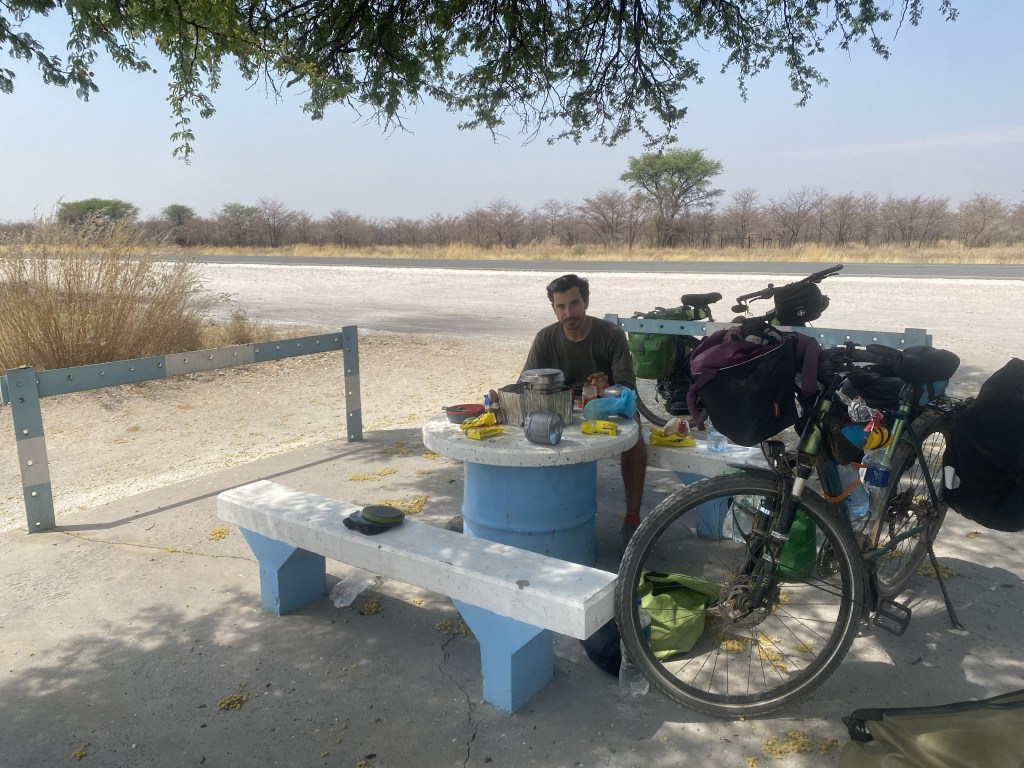
The flatness of Botswana starts slowly to disappear: some hills give some perspective of the surroundings and a bit of dynamism to the day. Most (if not all) trees are also fenced making it impossible to find a nice lunch spot away from the merciless sun. Luckily the road has also multiple lonely rest areas, made out of a stone table and benches below a tree. We use one of them for a lunch break, and push it to the first town in the road: Gobabis.
We arrive to the campsite with the best ioverlander reviews (i.e. with the best pool – with this heat, it’s an important factor). For a bit more of dinero, we can get a simple room, and we decide for it, after 5 days (640km) of camping in the bush and in antennas. As in every lodge in Namibia we will see, the owner is white and the workers black. It must be said, though, that, in general, the owners are a hands-on active part of the crew, taking care of multiple things such as electricity, plumbing etc.
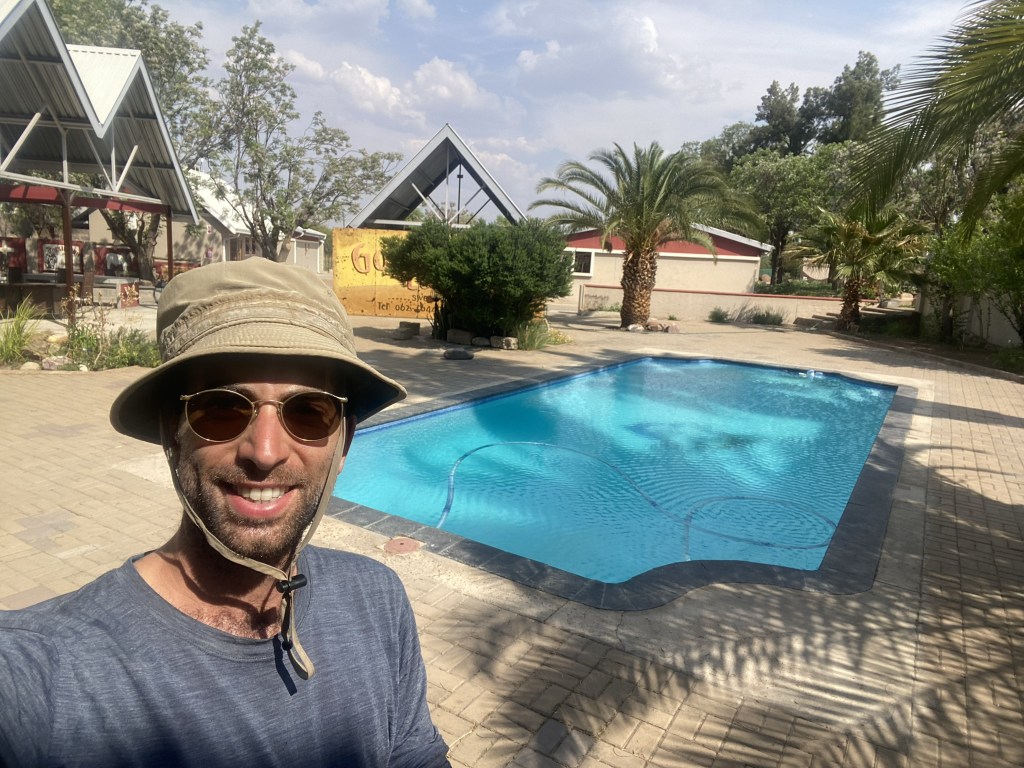
We have some to-dos, such as buying supplies and getting a Namibian sim card. Gaspard proposes to go to buy before the communication store closes, but Javi suggests not pushing it unnecessarily and taking a day off tomorrow, so we can relax a bit and plan the Namibian route, since we don’t have a clue of what we are doing. So we leave it for tomorrow, and spend the afternoon and evening relaxing by the pool, getting a huge quality burger for less than 5 Euro, what proves how meat intensive is the Namibian cuisine.
4/10 – Rest day in Gobabis
Ah, those days without doing nothing are the best. We still wake up early: Gaspard reads the news by the pool while Javi does some yoga and meditation. We start listing the different options for our Namibian route in the notebook. The clear thing is that we must be in Windhoek latest the 18th of October, since our girlfriends arrive on the 19th for a 2 week road trip. We obviously want to avoid the places we will see with them, and that leaves us just a few realistic options. We want to avoid tar roads, as they end up being boring. After quite some research and brainstorming, considering even renting climbing equipment so we can climb Namibia’s most famous mountain, the Spitzkoppe, we end up deciding for a loop in the north that crosses some scenic areas, and ends up in Swakopmund, by the sea, where we can finish the trip and return in bus to Windhoek.

We go for lunch and for the sim card to the town centre. But we find no restaurants, (everyone points us at the shoprite supermarket take away) and the telecom shop has its system down, so no chance to get the sim card. We end up eating in a braai (grilled) take-away place, run by some friendly colored women. Unfortunately they only have meat (no sides or vegetables) so we head back to shoprite (takeaway) to get some side vegetables. We notice many (older) women are wearing very colourful clothes with vibrant patterns. The dress is topped off with a triangular hat (cow horn shaped): These are Herero clothes. They have held to this piece of fashion from the 19th century and wear it as a reminder of the tribe’s history, when the German almost exterminated their entire tribe.

Back to the Braai restaurant they tell us that the meat, which is excellent, by the way, is of their own farm, run by their father, an old white man sitting by them, looking to the horizon in a lonely way. Funnily the women working there are the first people we meet not believing that we are travelling by bicycle (despite coming by bicycle to the restaurant). “We know how you do things. You are putting the bikes in a car, take them out to take some photos and continue”. It seems instagram has created a distorted reality where people could do that. No point to try convincing them.
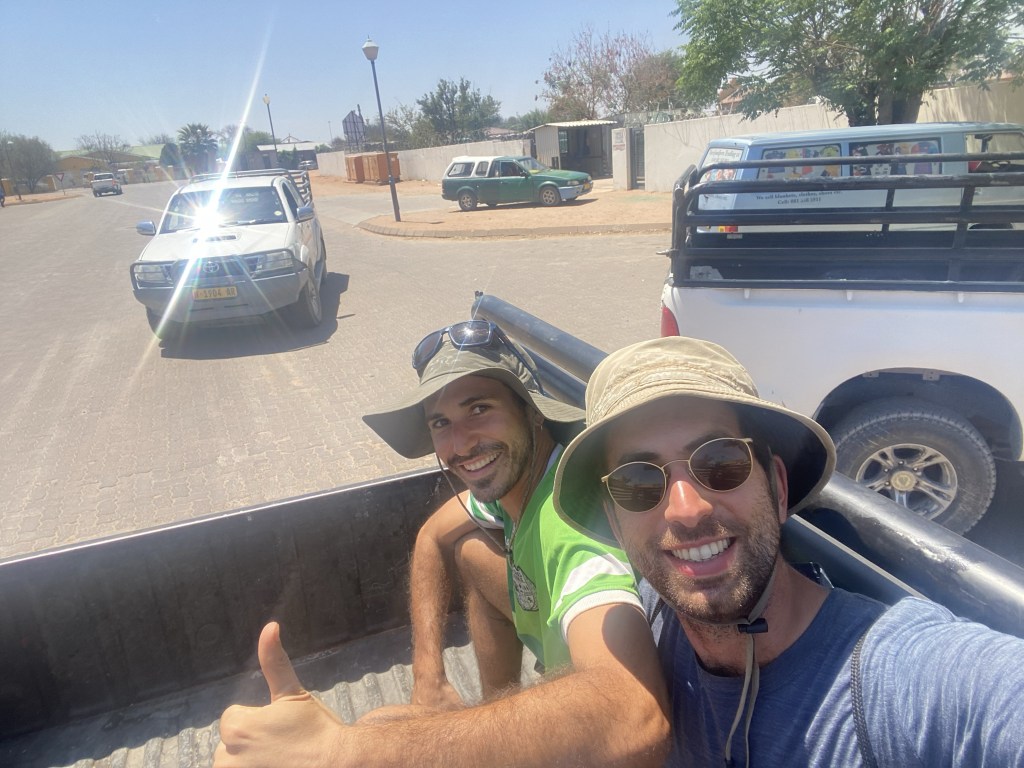
In any case, the women convince their father to show is his house, and they tell us that “people of your skin color love the house of our father”. That weird wording intrigues us and jump in the back of the pickup of the man, who brings us to it, with a big surprise awaiting.
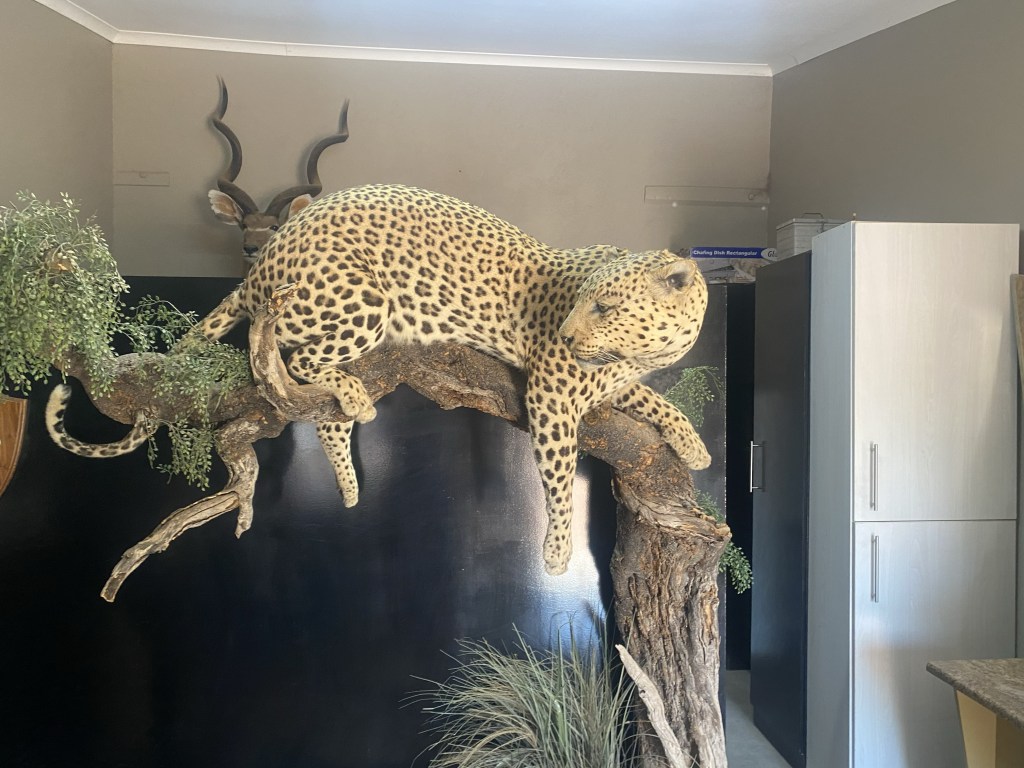
The house is literally full of taxidermic pieces of his hunting days. The man, who doesn’t speak much English, only Afrikaans, was an avid hunter, and among his prizes, we can see humongous elands and antelopes, giraffes, and a leopard. He told us that he got permission to kill the leopard since it had a defective tooth that had him in deep pain and he was unable to hunt, making him attack cattle. He explains us in a broken English where the animals need to be shot in order to both kill them quickly and preserving the body (skull) to stuff and expose them.


Despite our far distance from hunting activities, and our very low level of meat consumption back at home, we decide not to judge, and focus on learning the lifestyle of this man. After the visit, we discuss the topic among us and end up agreeing that there is little moral difference between eating pork or beef, and participating in legal hunting of non-endangered species, since both activities are absolutely not necessary for the subsistence of a human nowadays.
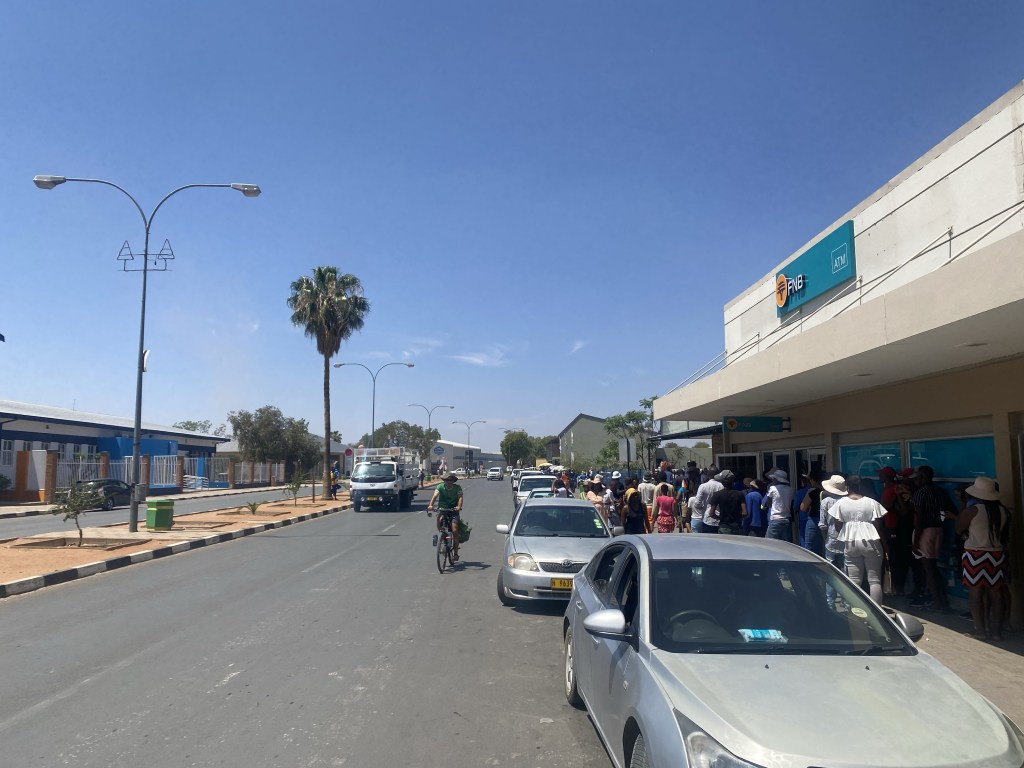
We go back to the hotel and decide we will go back to the sim card show 30 minutes before it closes (hoping the system will be back up). Gaspard is suggesting to flip a coin to see who will do the 4 km from the hotel to the shop but javi doesn’t to play this game again. Javi believes Gaspard is the luckiest guy in the world and has no chance against him in any randomized game. So, As javi lost a few days ago, Gaspard will go this time. Back in town, the sim card shop is still out of service, so we decide to try to get one in the airport. For tomorrow, we decide to aim at a town nearby it, where ioverlander says that an old man happily lets you camp by its shop.
So, after calling our relatives, we get some food at the lodge, given the lack of restaurants in town, and go to bed, ready to get again on the bike. The big surprise of the night was the “on the house” desert we received that made our day.

5/10 – Gobabis – Seeis. 150 km, 580m+
Fences and more fences everywhere. We get on cycling without many expectations for the landscape in this area, although we do stop to observe the windmill pumps for waterholes, a classic in all of these farms, and a great way for us to spot boreholes from faraway. The design is simple yet very effective. The blades of the windmill wheel catch the wind which turns the rotor. While the direction of the windmill (perpendicular to the inflow) is being changed by a rudder at the back. The rotary motion of the wheel is converted into an up and down motion pumping water into a tank.

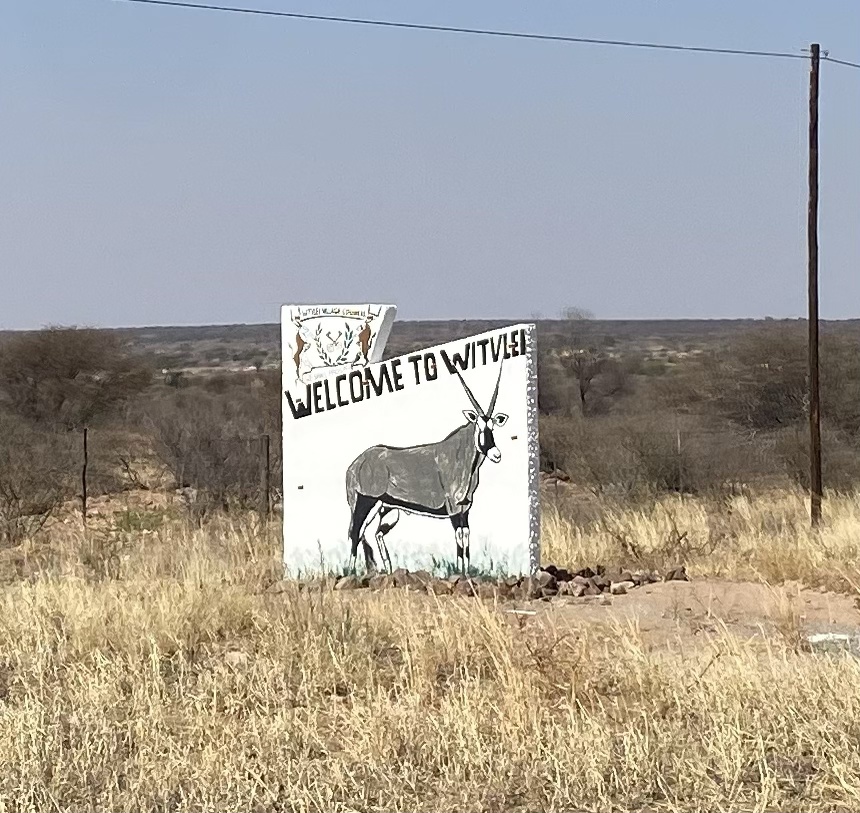
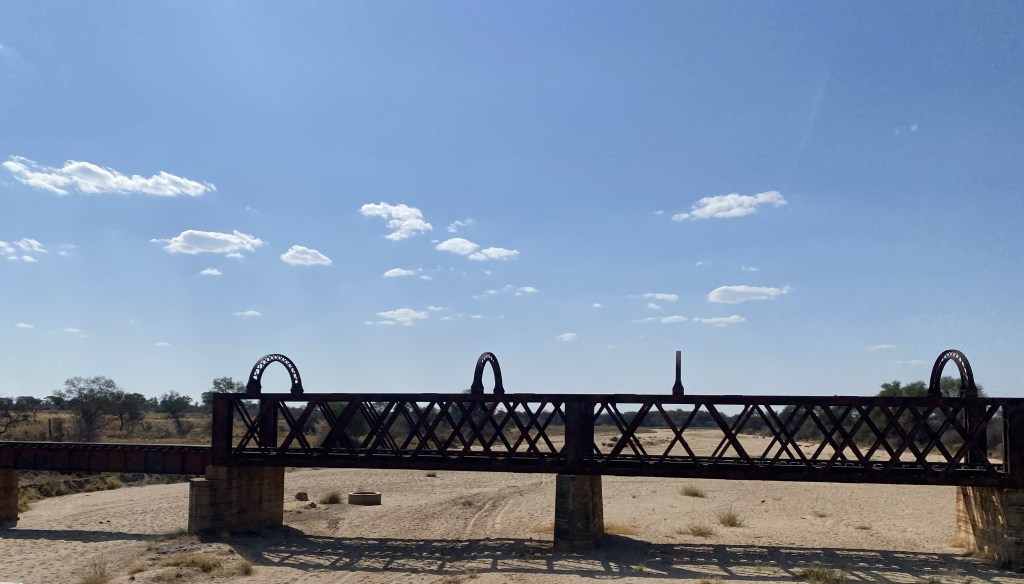
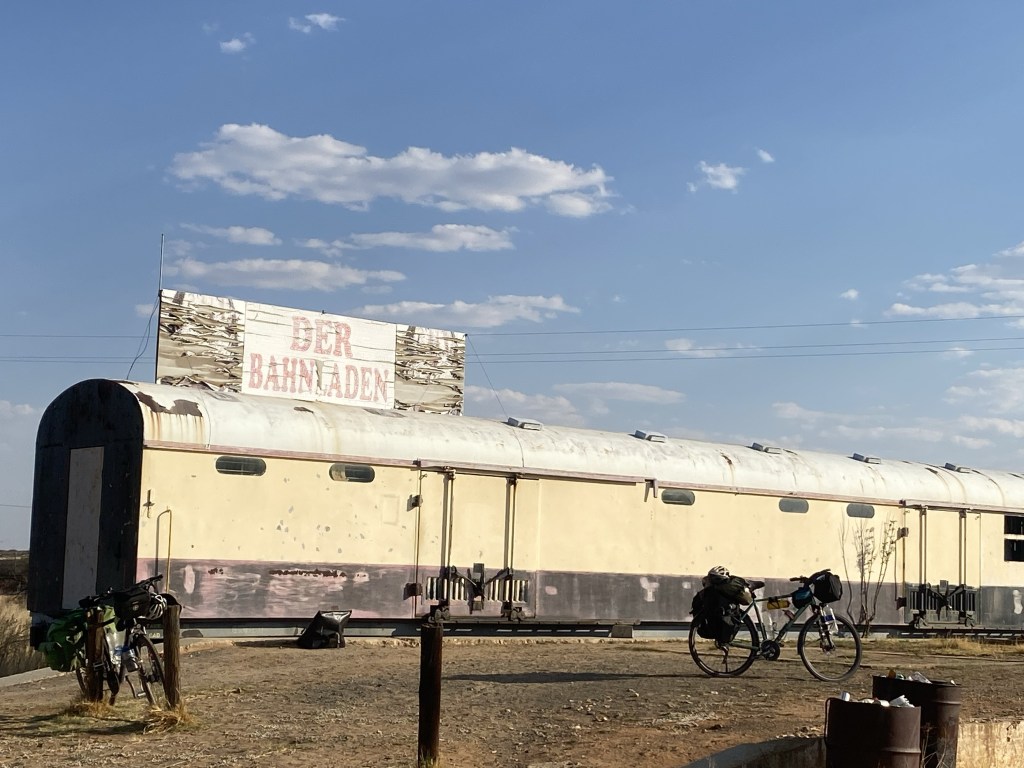
Kilometres (and podcasts) go by and by, while the wind plays games with us, sometimes helping, sometimes not. We follow a long-time-unused train line all along, and we eventually arrive to Seeis, where we can see the wagon shop, located unsurprisingly on the railroad.

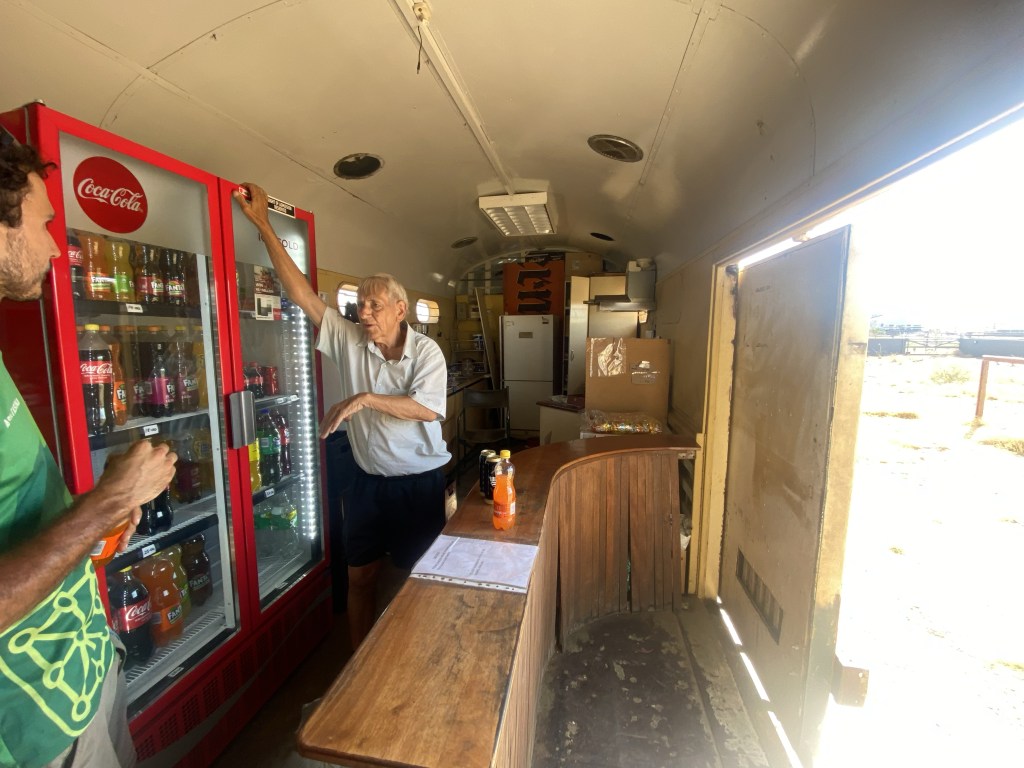
It’s called “Der Bahn Laden” (which would translate in the train shop), and the owner, Bennie, an Afrikaaner who gave the shop a German name out of respect to the German-majority community in town, lives in the farm in front. His dream was to have the shop in an old English bus, however it costed five times more than the train (including delivery) so he settled on the much cooler train shop.
Bennie is a very talkative man, closer to his 70s than to his 60s, who immediately opens the wagon to offer us a cold beer. “People like you, coming to Namibia by bike, deserve at least one beer from us Namibians”. He invites us to camp in his garden, to be “safer”, and lets us use his bathroom within his home. What a legend. Since he used to work as touristic guide, we double check all our questions with him ,in an old-school huge map. A bit later, his wife Mary Anne arrives from Windhoek, where she works (only 60 km away), and we spend a very nice time with them, sitting on the back of their car, while the sun goes down. Meanwhile the locals keep popping up to the shop. One buying a few cigarettes (as he does everyday), even though buying individual cigarettes cost 50% more than buying the whole pack. Interesting how people are living by the day compared to European way of living “in the future”. The next local is buying some call credits. A huge business for the Namibian government (200 Mio Namibia ~ 100 k USD monthly revenue) since its introduction. Bennie is taking a 10% cut in what he sells which is a nice complement for him.

We learn a good deal about Namibia, although it’s obvious that they think things where much better when they were part of South Africa and ruled by the white minority. “At least things worked”, says Bennie, putting as an example the train system collapse upon independence. They complain about police corruption, putting as an example having caught people stealing his goats paid by the local police officer, so they could enjoy some meat. For that reason, they don’t trust them in case of an incidence and Bennie has his own arm at house, which he practices with in a nearby shooting range. “I am ready to shoot if some enters ilegally in my property”. They seem scared by the farm assaults that happen in South Africa, fearing they could propagate in Namibia. Gaspard tries to interject that you do not need to kill someone entering your property but could aim at the legs if you feel endangered. At the same time it is hard to fully appreciate the danger of their life in Namibia.
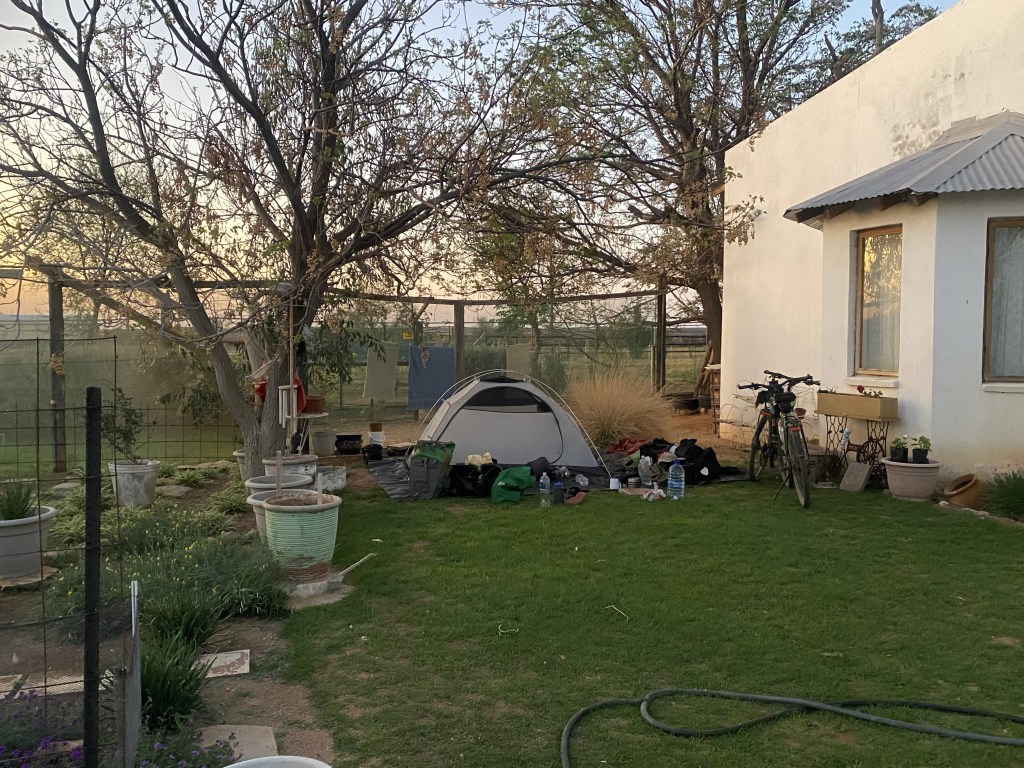
A bit confused by their endless kindness towards us and the conservative approach to other areas, we go to bed thankful and reminding us not to judge too fast, once again. Time you spend judging is time you don’t spend observing, and, thus, learning.
6/10 – Seeis – Windhoek. 61 km, 560m+
Although we are pretty close to Windhoek, the traffic starts to get pretty bad, and the non-existing road shoulder makes it quite dangerous. We stop at the airport for a MTC sim-card, for which we pay 15$ for 18 GB lasting 30 days.
We start passing quite luxurious-looking villas, and suburban condos. The traffic keeps getting worse, but our luck has improved: Cronje, a warmshowers user we contacted, tells us that he can finally host us, and sends us his address, although he mentions he and his family will be short on time, since his daughter is having her prom tomorrow (they call it matric).
We enter Windhoek from the East and immediately leave the main street, which was driving us mad. We first pass through the suburbs which consist of copy paste houses.
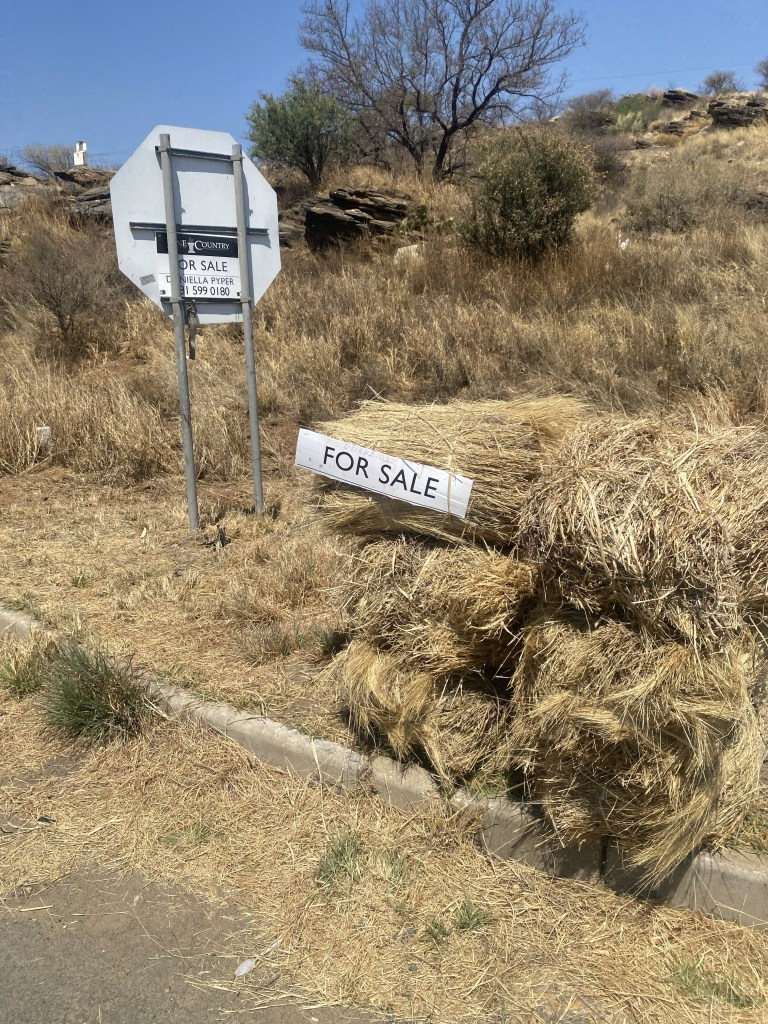
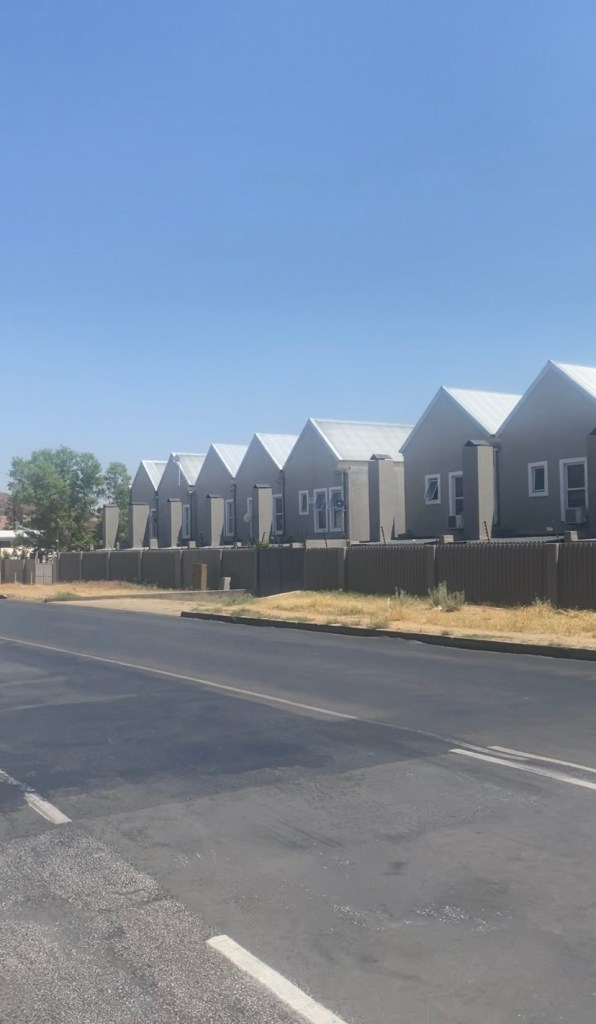
Gaspard goes very slow, showing some signs of sickness that will later manifest more clearly. We are obviously on the rich part of town, with imponent villas protected with bare wires, and malls popping around. Multiple people have told us to watch out about our safety in Windhoek, which, although is not comparable to South African cities, it’s still famous for a high level of petty crime and assault.
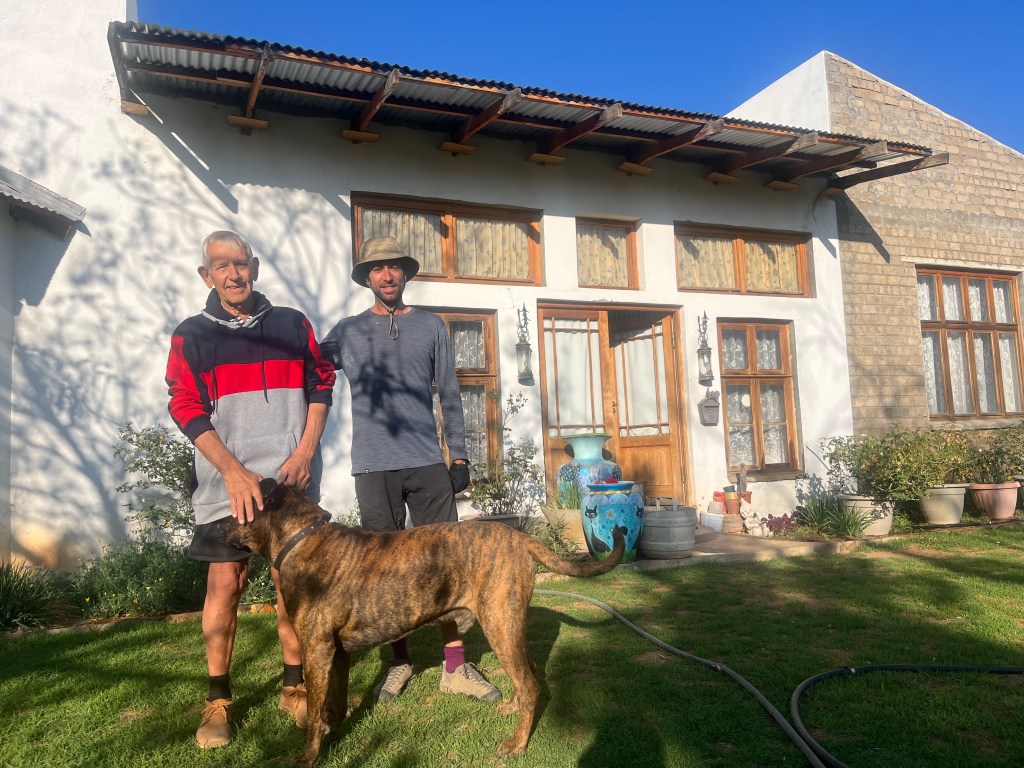
So we don’t lose our time and move diligently to Cronje’s house, a beautiful two story house with a small garden, lacking many the threatening security measures of their neighbours, making it much more welcoming.
Like in Lusaka, it doesn’t take long to feel at home: Cronje and Mary are in their early fifties and are very active cyclists. In fact, they are participating on a mountain bike race tomorrow. They are also planning a cycling trip to France, that’s how they learned about Warmshowers. Cronje is an Industrial Engineer working in a painting company, while Mary works in property valuation. 2 of their kids are studying Uni in South Africa, while Karin is just finishing high school. They obviously enjoy an upper class train of life, but they are very modest, discrete and extremely welcoming. In fact, as soon as we arrive, we sit for lunch with them, welcoming us to pray, holding hands. Despite not being (very) religious ourselves, the way they do it, and the words they choose feel very welcoming and far from awkward, and we will do it like that for every meal we will share at their place.
The family is busy with the prom of Karin, so we go shopping for the next days, hoping to cook some nice stuff for them. Cronje has also to go shopping so we go together. Cronje smarting challenged us to a “one pot” competition. Gaspard, who is a proper chef compared to Javi, takes it very seriously and decides for a beef stew (boeuf bourguignon). We spend the afternoon cooking it for tomorrow (as a stew is always better the next day) and relaxing, while our clothes clean in the washing machine (set up by the house assistant, Elena). Too much (undeserved?) luxury.

Once they are back from the matric celebration (without Karin, obviously, who stays for the well deserved party) the Lofties prepare for dinner a delicious braai in their terrace, but they abstain from the beers and wine we bought, since they have a mountain bike race tomorrow morning.
7/10 – Rest day in Windhoek
As spoiled before, Gaspard spends half of the night in the toilet, suffering from cramps in his stomach. We still don’t know what made his stomach sick, since we both ate and drank the same, although Javi suspects it is because he is not drinking as much beer as him.
In any case, our plan to visit a farmer market before going to see the mountain bike race blows up, and we arrive at the race when Cronje and Mary are already done. Dammit.
We nevertheless get to enjoy a moment with our hosts, who seem to have enjoyed a lot the race, and to check the cycling scene in Windhoek, which is surprisingly big. Although mostly made out by whites, we are happy to see quite some diversity with colored and blacks. We also get to talk with the folks of Cycletec, a company we had contacted to ask for 2 bike boxes to ship our bike back home when the adventure is over.
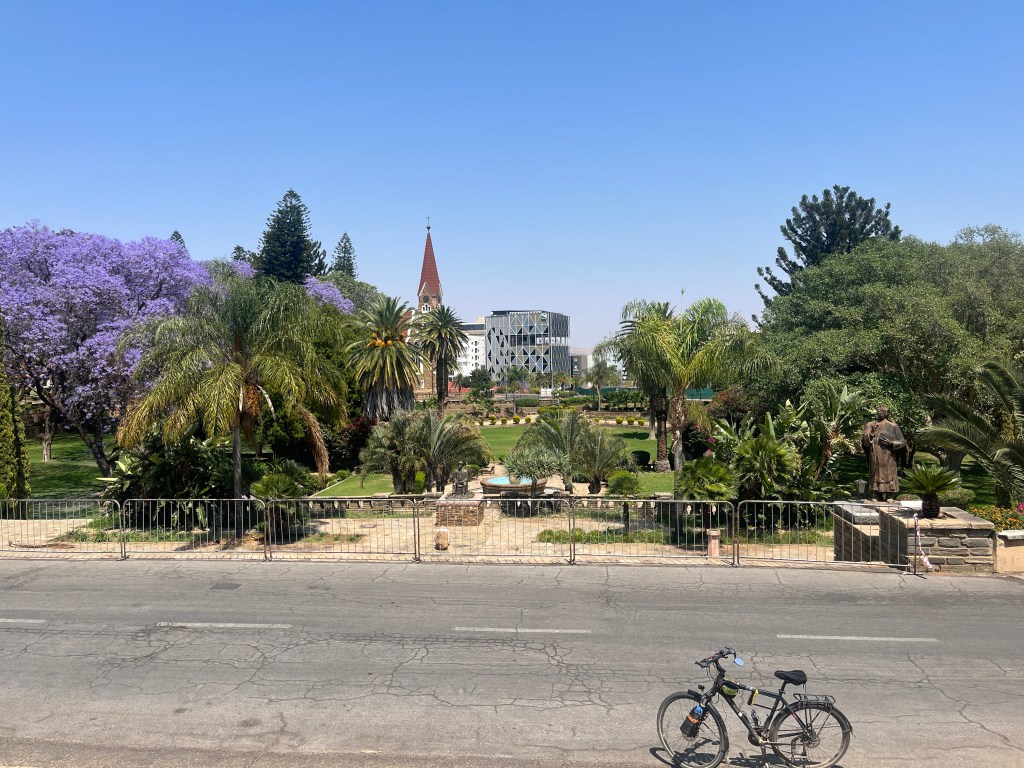
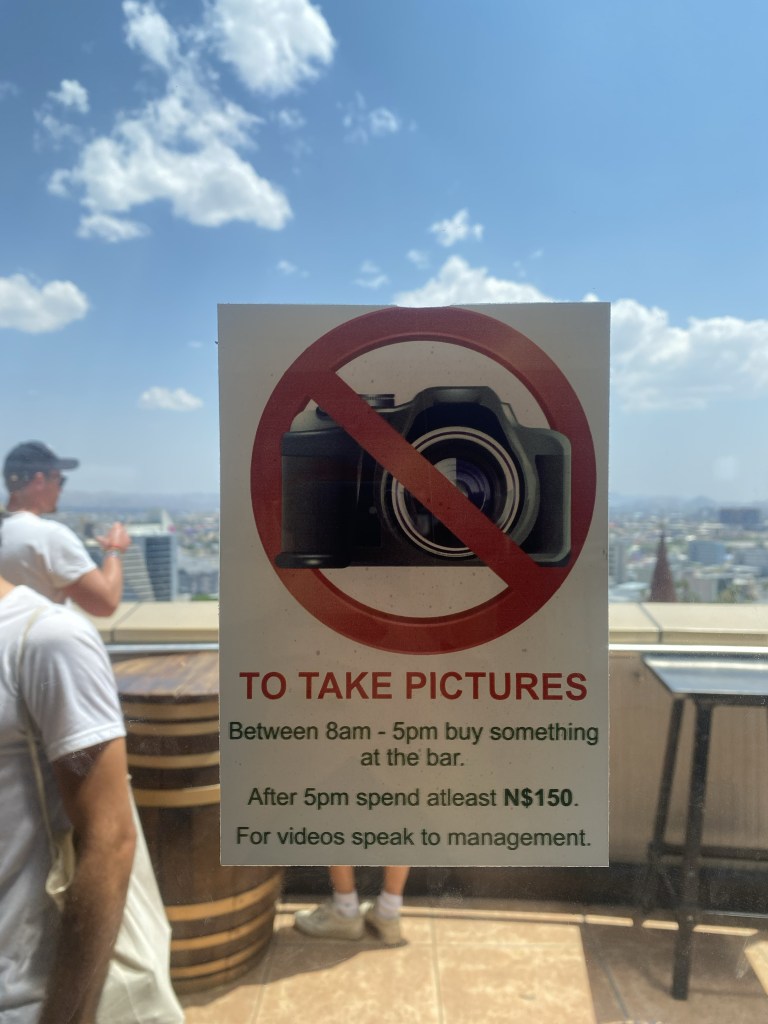
It´s 11 AM and its slowly time to get to know Windhoek better. We cycle to the town center, only 15 minutes away from our hosts´place. We find that all landmarks are conveniently located hundred meters from each other, and that all the museums and churches we wanted to visit are inconveniently closed because it’s a Saturday. We do get a glimpse of the Parlament Gardens and the statues that honor Namibiás liberation and remember the genocide undertaken by Imperial Germany against the Herero people in early XX century. Curiously enough, both the statues and the museum were built by North Korea (yes, North, you read well). Although the museum is closed, we can jump on the elevator to enjoy a privileged view of Windhoek.



We also check the Old Zoo park, where there should be an elephant column that we can’t find. A local woman speaking perfect German approaches us. She lived in Germany for 30 years but she decided to get back to her routes. She lives in the streets and begs us for money, although she has fresh new nike shoes that she brags about. She says that she only smoke a joint now and then, unlike her colleagues in the park who are always smoking crack. OK, time to leave.
Despite the few highlights, we get a very good impression from Windhoek, which seems much more livable than Lusaka. There is a proper downtown, and, although the city is seggregated by purchasing power and, unfortunately, thus also by race, there seems to be a cultural dynamism that we didn’t see so far. The bike race in the morning, and by the National Museum, a jazz festival seems to be unfolding.
We go to the gate to inform ourselves, and we end up meeting a frenchman named Antoine, who claims to be one of the organizers, and insists on us joining at 4 PM, when it starts. He lives in Luxembourg but was previously living in Versoix, a small municipality in Switzerland where Gaspard’s girlfriend is from: how small is the world. He keeps speaking French to Gaspard despite Javi’s attempt to jump in the conversation (in French or English). Javi isn’t amused.
We find the price very expensive for local standards, as it costs 16 Euro. We will then find out that a famous South African singer is coming, Jonathan Butler, but we expect that with this price only the high class of town will attend.


We go back home, so Gaspard can get a siesta and recover for the festival. Javi meanwhile attempts at cooking a Spanish tortilla for the host family for lunch, but he ends up failing big time. Javi claims it was because of the excess of adherence, but haters are always gonna hate. Surprisingly, the Lottie claim to love it, although they do find it filling.

We agree to meet the family for dinner at 8 pm, so we can have Gaspard´s stew, and we have time to enjoy the festival a bit before. As expected, the start time delays from 4 pm to 6 pm, although doors are open, and we can chill on the grass, talking to other people. We talk with two German couples that moved to Namibia for their retirement. There is apparently a big German community doing so. Property prices must have a saying, but the country’s natural offer probably too.
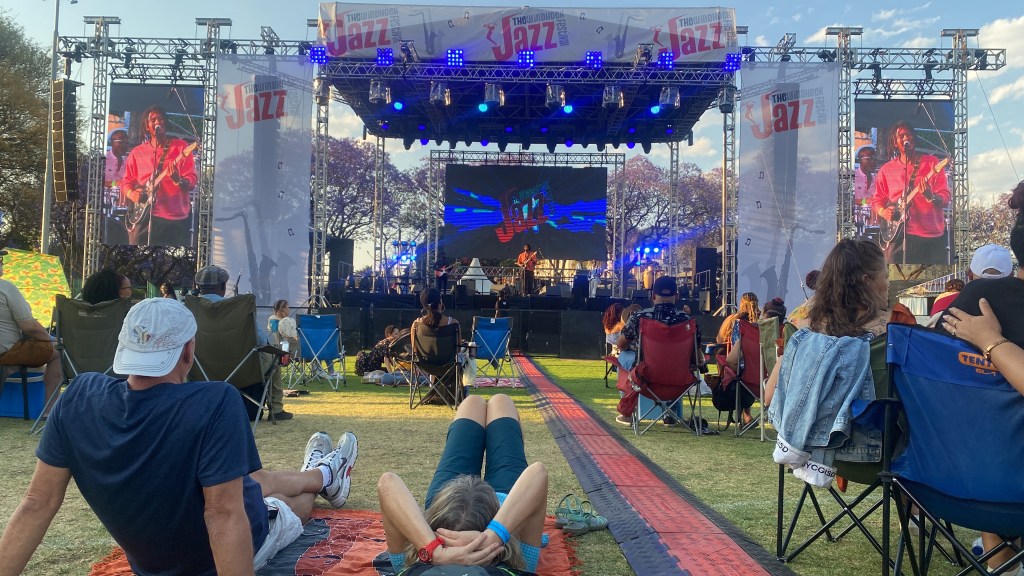
Apart from us and some other obvious tourists, most of the audience is made by black and colored, and there are very few whites that we can identify as non-tourists. Seems that music tastes is also split in the country. The music starts and its fantastic: jazz bands with African touches and instruments delight our ears, and the audience slowly stands up from the comfortable grass, and starts moving the hips. We meet people that have come from other towns for the festival. We also meet Antoine, who comes to us, or better said, to Gaspard, as he seems to only want to talk French. He brags a bit (actually, quite a lot) about his career and love achievements, and keeps trying to prove how well connected he is in the Namibian ecosystem. He participated in the race car “Le Mans classic” and is now a reporter/ concert organiser. His son, Antoine, was also doing car racing (former European champion), and he was financing his training for up to 600k euro per season. In a last attempt to “teach us how to live” (or impress us), he tells us the classy sentence “once you go black you never go back”. We don’t know what to answer. „Felicitations, mec“, we guess.

We return home for the dinner, and thank God the quality of the meal improves after the disastrous Spanish tortilla of Javi. The Lofties truly appreciate our culinary efforts, and altogether we have a great time. We keep learning about Namibia, with a lot of learnings about its energy situation: apparently they found off-shore oil, and they are currently assessing if it´s economically viable to exploit.
After dinner, we get back to the concert, brought by Karin, after insisting uselessly on a cab. “They are too expensive, we will bring you!” This family is just gold.
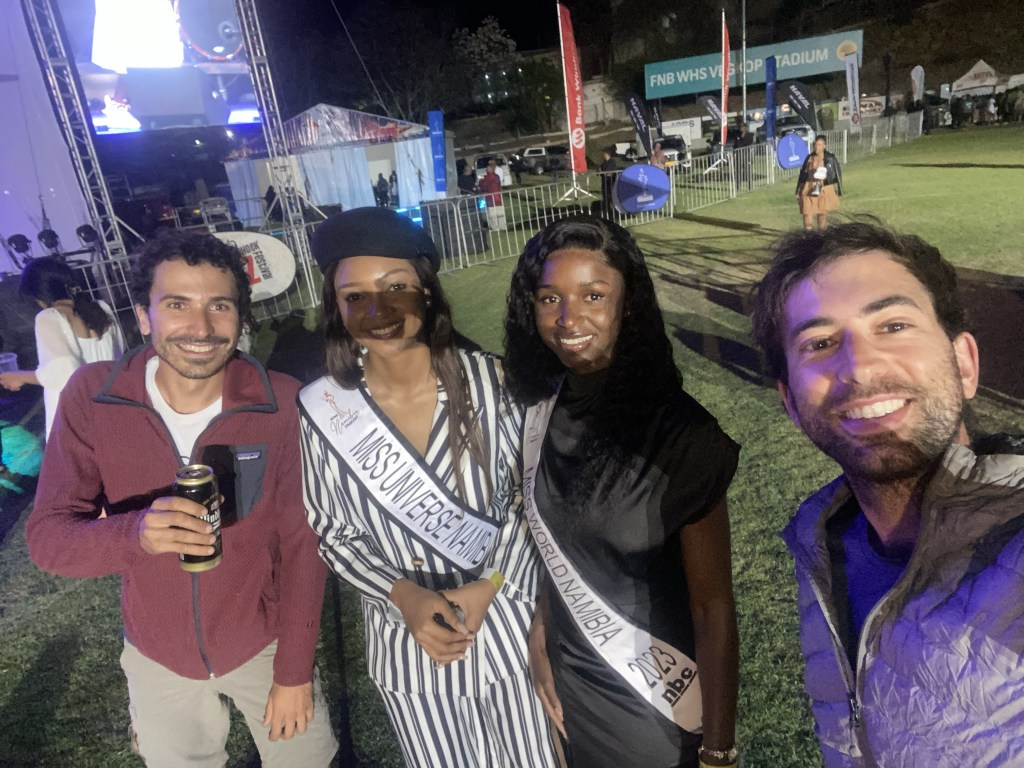
Back at the festival, we arrive on time for the final concerts, which are also the most famous ones. We dance a bit with the locals, realizing that surprisingly only mature women are interested on us. We do talk a bit with two Miss Namibias, who are just there in the audience, to send a picture to Antoine to make him jealous. They are actually quite down to earth. We are fascinated by how all artists, after performing, they join the crowd for the festival, merging with fans without any issues. Pretty cool.
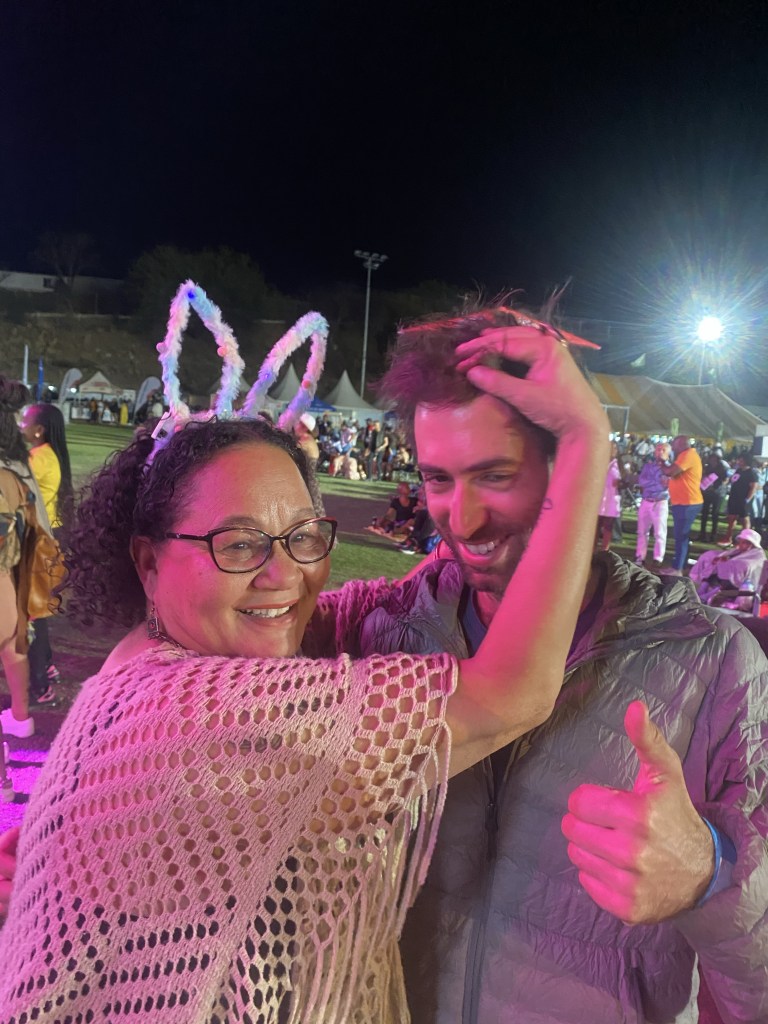
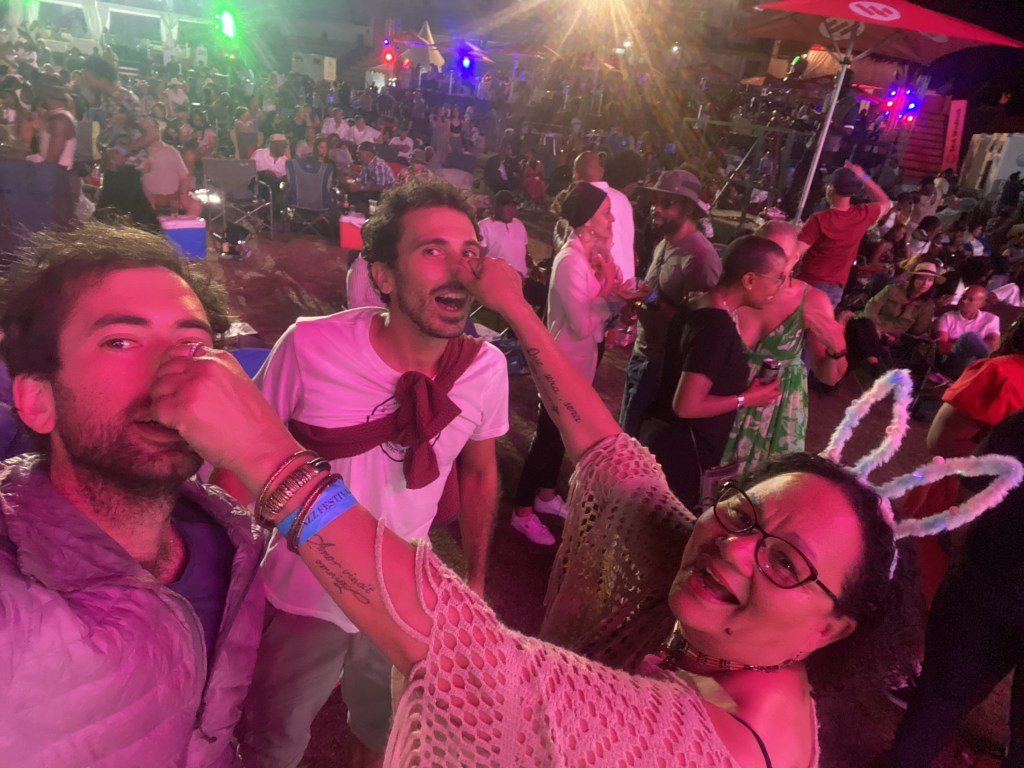
The music beat starts going up, and by now everyone is dancing to hypnotizing tunes. A woman on her 50s with a rabbit hears crown really takes it on us, or better said on our noses. She finds them very funny and distinct from hers, and she keeps asking if we are Turkish. She is the queen of the audience, talking to everyone and dancing with the artists, show presenters… Another woman in her 50s tries to hook us up with her daughter, and after a bit, we are really wondering how old we actually look.

And the time for the final concert arrives. Jonathan Butler, a black South African musician from the 80s, comes into the stage and the audience goes literally crazy. One can tell that a good portion of the people came mainly for him. He sings powerfully and he is very, very talented playing the guitar. The audience sings the songs to chorus and the whole thing is very beautiful. When we suspect the end of the concert, we call a taxi with the local Uber-like app, and make it comfortably and safely to our hosts´ home, ready to rest.
8/10 – Bus cheating from Windhoek to Otjiwarango
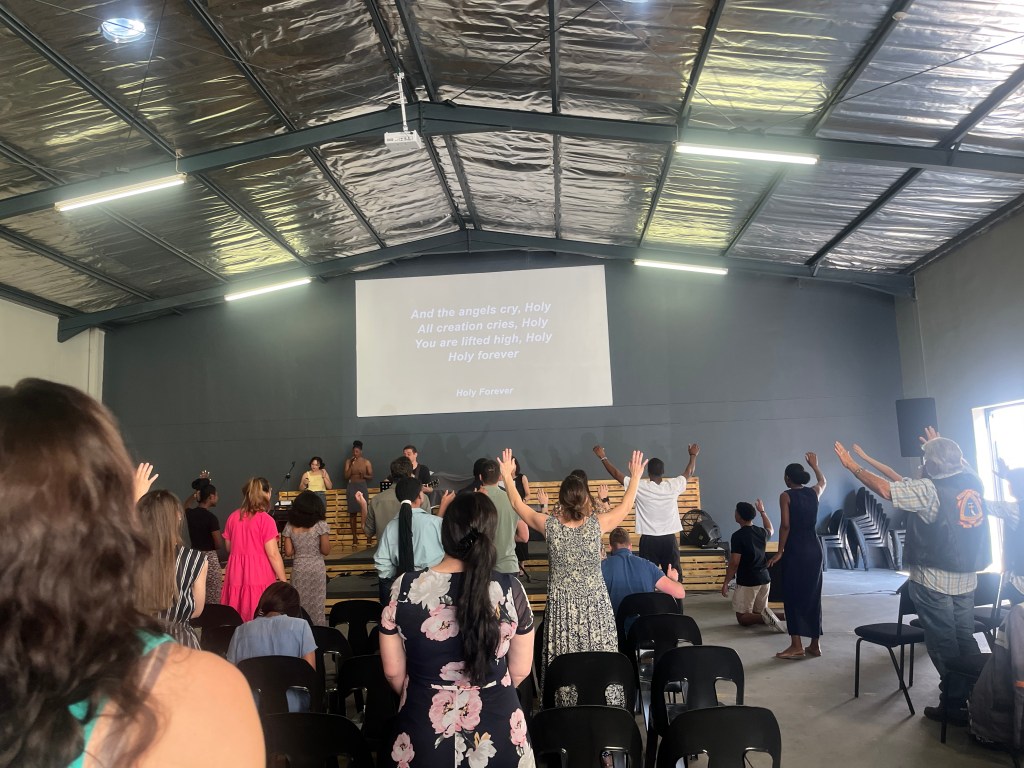
Gaspard is by now fully recovered, and Javi managed not to smoke at the concert, so he has no hangover. We split in two in the morning, Gaspard stays home calling relatives and Javi goes with the Lofties to church, curious to learn how people live religion in Namibia. We go to a Family church, and I don’t manage to find the specific denomynation out. It is located in a big warehouse, and seems to have started off recently, under the leadership of a Afrikaaner married couple. The audience is very mixed, and people are dressed normally and look friendly. Lots of young people. The singing prior to the preach is accompanied by a rock band, while people rise their hand palms, some even kneel in front of a non existing altar (there is not even a cross), what gives some US church vibes.
The time of the preach arrives. I am curious to see if this detonates into a rather fundamentalist discourse or if the positive vibes are consistent. The preacher, a cycling friend of Cronje, ends up being a very down to earth guy, who spends around half an hour giving examples of how to use the message of Jesus in the interest of your wellbeing and of your relatives. He talks about the ego, pride, and the importance of opening your house to others and be generous. Both the Lofties and myself have to laugh, like if his speech was predestinated.
After the preach, I drink some coffee while talking to some people around, including the priest, who asks me if he can pray for my well-being in the road. Somehow, it becomes quite touching and emotive. The young people I talk to are friendly and welcoming, so I end up leaving the ceremony very happy to have joined.
After church, we join or hosts for a final braai, again with top quality meat, and some grilled cheese sandwiches. We give them tips for their trip in France, and insist that the doors of our homes in Switzerland are open, both for them and for their children, in case any Loftie fancies a de-tour around.
The time for our next move arrives, which is cheating by car or bus to Otjiwarango, a town 250 km north of Windhoek where our freshly designed route up to Swakopmund in the Atlantic Ocean starts. Although we are not fans of taking the bus, we are short on days, and we would rather avoid cycling main roads full of traffic, and focus on the dirt roads that bring the magic.
Mary, Cronje‘s wife, has found us in some ride-hauling whatsapp group a couple that does the exact segment we are aiming for. But, despite mentioning they will pick us up in the afternoon, it‘s slowly 4 pm and they are hundreds of kilometers away. So we check our options and decide to give a try to the line bus coming from Cape Town, who stops in Otjiwarango after Windhoek, despite them having told us that they don’t take unboxed bikes.
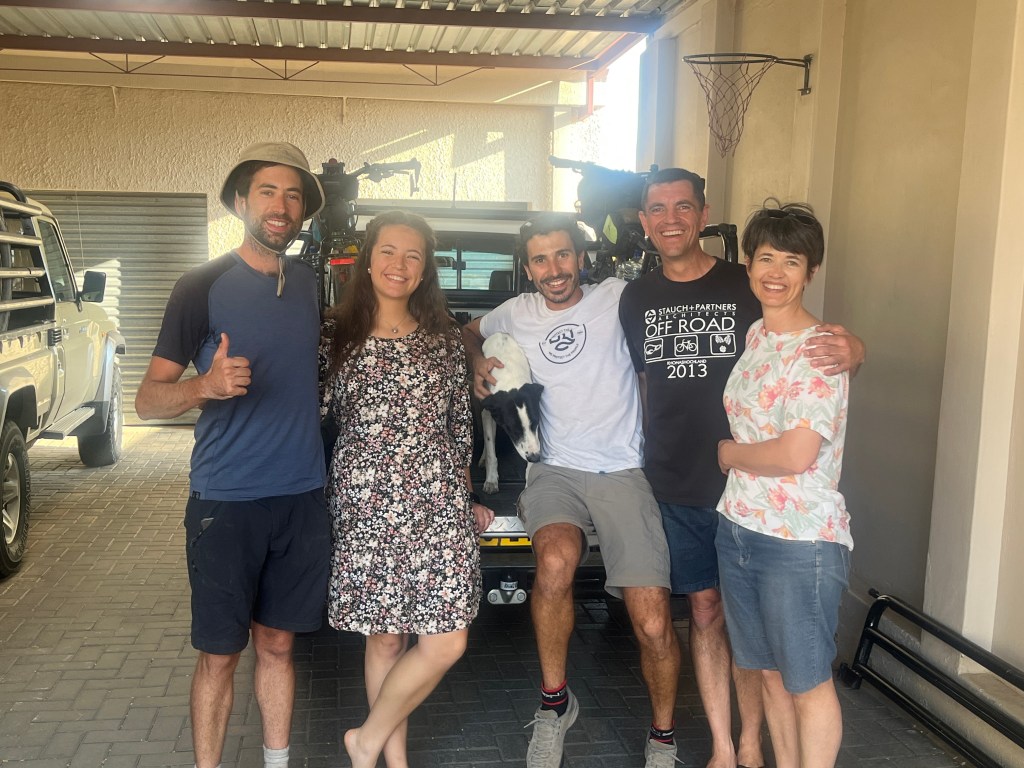
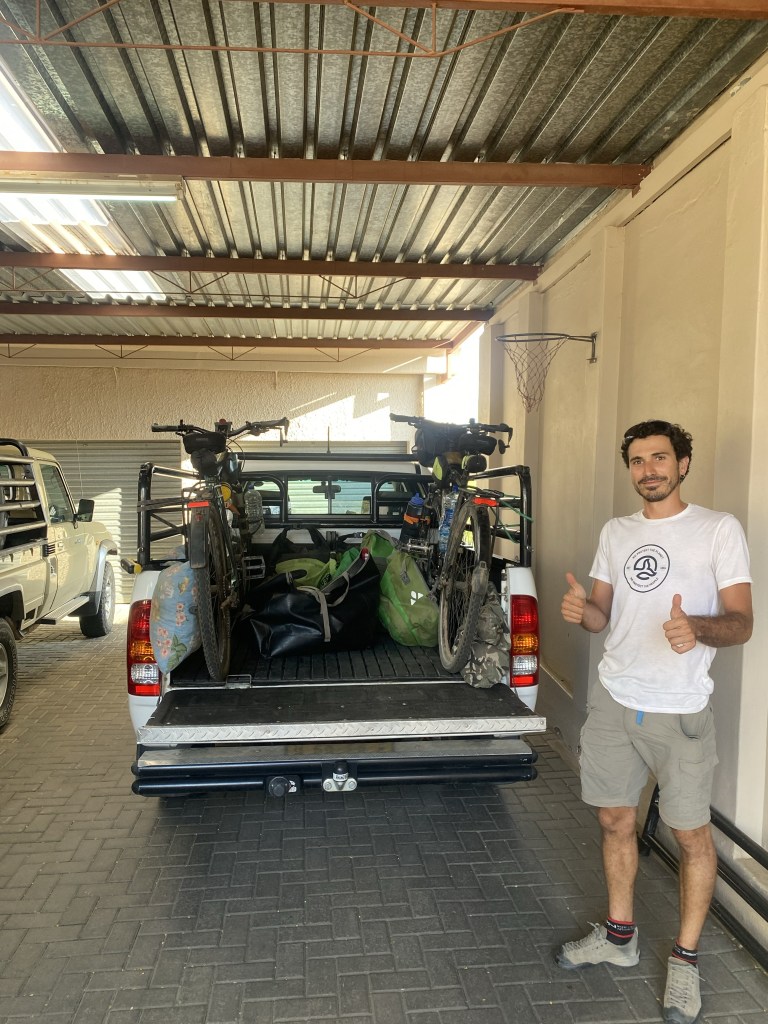
The Loftie‘s insist on bringing us and the bikes in their pick-up (Afrikaners call it buckie), and we have already learned there is nothing to do against the endless kindness of this family. We arrive at the station and bingo, we get tickets and no one cares about the bike not being packed. Tickets sold are for the wrong date, so we need to queue again to exchange them and get a voucher for the price difference -despite being an error from the company. Another example about the huge desconnection of theory and practice in Africa. So, after exchanging a big hug with Mary and Cronje, we depart Windhoek, while the sun sets making the sky explode in colors.

Once in Otjiwarango, we satisfy our hunger at the take-away of the gas station where the bus leaves us. The station workers and a group of teenagers warn us about cycling so late (it‘s 9 PM) to the hostel we have found, claiming there are many thieves in town. We call the owner explaining the feedback we got, and he immediately comes with his car to escort us for the 10 min cycle to his hostel. Obviously nothing happens, but these warnings are always so confusing, you never know if they are exaggerated or not.
The hotel, Kuhanga Villa, ends up having one of the best quality / price ratio we have had so far, getting a solid room with AC, private bathroom and kitchen for 7.5 Euro each. It doesn‘t take long before we fall deeply sleep, as tomorrow our final Namibian offroad tour starts.
Day covered in this post (total): 6, out of 77 days
Kms covers in this post (total): 344 km, out of 4770km.
Positive elevation covered in this post (total): 1600m+, out of 35700m+
 Cycling Pirates
Leave a comment